Up to15% off Third-party tested
Third-party tested
BPC-157
Tissue Repair & Healing
10mg
$60
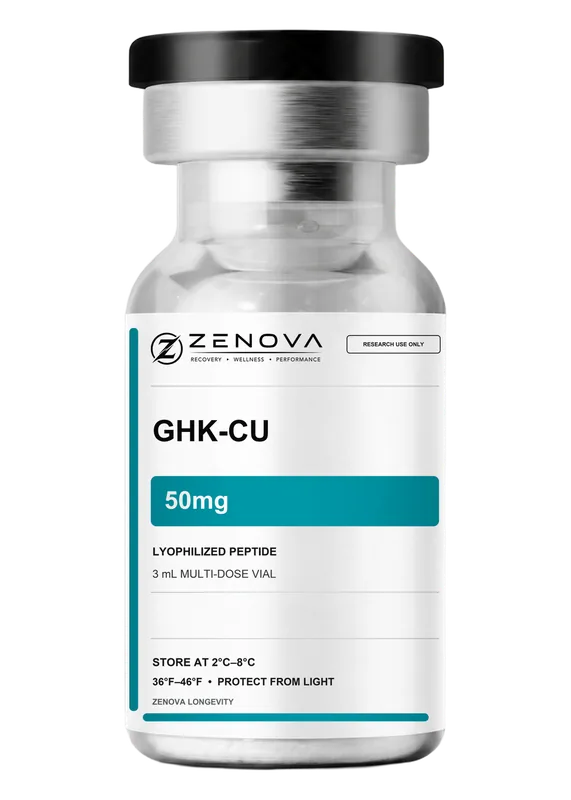
Also known as: Copper Peptide, GHK-Copper, Glycyl-L-histidyl-L-lysine-Cu
GHK-Cu is a natural peptide made of three amino acids (Glycyl-Histidyl-Lysine) that holds on to copper. It is found in human blood plasma, saliva and urine. Levels drop a lot with age — from ~200 ng/mL at age 20 to ~80 ng/mL by age 60. It is well known for its effects on skin renewal, hair growth and wound healing. Studies have shown it can turn on over 4,000 genes linked to repair and renewal.
Size
Bundle & Save
$40
50mg
Free Xpresspost shipping on orders over $199
In plain English
GHK-Cu is a tiny peptide that carries copper, and your body makes it naturally. It is studied for smoother skin, hair growth and helping wounds heal.
Your body makes less GHK-Cu as you get older. GHK-Cu carries copper into cells. Cells use that copper to run helpers that build collagen, the stuff that keeps skin firm. In studies, it also switched on thousands of genes linked to repair.
Good to know
Every batch is tested by an outside lab, and the report is on our Lab Results page. Sold for laboratory research only. Full details: Shipping Policy.
Time in the Body
About 0.5–1 hour (but its effects in the body last much longer)
Common Dose
1.5–2 mg a day (about 10–12 units on a U-100 syringe)
How It Is Given
Injection under the skin (switch spots — belly, thigh)
How Often
Once a day — many use it daily for steady skin and collagen results
GHK-Cu carries copper into cells. There, the copper helps enzymes (helper proteins) that build collagen, protect cells from damage (like SOD) and repair DNA. GHK-Cu turns on 4,000+ genes. These genes are linked to rebuilding tissue, healing wounds, protecting cells, calming swelling and stem cell work. It also lowers cytokines, the signals that drive swelling (inflammation). And it tells skin cells called fibroblasts to make collagen, elastin and other key parts of skin.
Notes
Comes in 50 mg and 100 mg vials. 50 mg vial mixed with 3 mL bac water → ~16.67 mg/mL: 1 unit = 0.167 mg (10–12 units a day ≈ 1.67–2 mg). 100 mg vial with 3 mL bac water → ~33.3 mg/mL: 1 unit = 0.333 mg (5–6 units a day ≈ 1.67–2 mg). GHK-Cu often causes short-lived stinging, redness or itching where it is injected — inject slowly and switch spots. A cycle is 4–8 weeks (some go 6–12 weeks to see skin changes), then 2–4 weeks off.
Lots of research over 40+ years, especially on skin and wound healing.
Powder: keep in the fridge. After mixing: keep in the fridge and use within 30 days. Keep away from light.
For research only (injectable). Versions you put on the skin are common in beauty products.
Already filled in with GHK-Cu's vial size. Enter how much water you added and the dose you want. We will show how many units to draw.
The mg number printed on the vial label
How much bacteriostatic water you mix in
Micrograms (mcg) you want each time
How much your syringe holds
Strength per mL
—mcg/mL
Amount to Inject
—mL
Fill Syringe To
—units
Doses per Vial
—doses
Fill in every box above to see your results.
Pick the vial size, enter how much you use each time, and how many times a week. We will estimate how long the vial lasts.
Save a copy of these numbers for your lab records.
This opens your email app so you can send the numbers to yourself.
Research use only. This calculator only does the math for trained lab staff. It does not suggest a dose, an amount to inject, a treatment, or any use in people. Always follow your approved lab plan, the product paperwork and the rules where you work.
Explore the catalogue
Drop your email and we’ll unlock a one-time 25% discount code.
Zenova Peptides
For laboratory research purposes only. Not for human use. Not medical advice.
Rated 5 out of 5, no comment left.
Sign in to leave a review. Reviews come from real accounts so people can trust them.